AI Search has not made business websites irrelevant. It has only exposed the difference between a website that exists and a website that actually explains, proves, and converts.
Customers may discover a brand on TikTok, Instagram, Facebook, LinkedIn, Google Search, Google AI Mode, ChatGPT, or Perplexity. But when they are seriously deciding whether to trust, compare, or contact a business, they still need one stable place to verify the brand.
That place is the website.
- Social media helps people discover you.
- Your website helps people understand and trust you.
- AI Search helps people compare and shortlist options.
- A strong website connects all three.
AI Search did not kill websites. It changed what websites are supposed to do. A weak website is easier to ignore now. A strong website becomes the brand's source of truth, trust layer, and conversion base.
Why This Question Comes Up Now
Business owners ask this question because customer behaviour has become fragmented.
People search through TikTok, Instagram, Facebook, WhatsApp, ChatGPT, Perplexity, Google Search, and Google AI Search. Social media feels faster. Websites can feel heavier. A reel can get attention today, while a website can feel like a longer project.
But attention is not the same as trust.
- Someone seeing your content does not mean they trust your business.
- Someone liking your post does not mean they are ready to enquire.
- Someone watching your video does not mean they understand your service.
- Someone following you does not mean they know why they should choose you.
This is where websites still matter.
A website gives serious customers a place to slow down, understand what you do, compare your proof, and decide whether your business feels credible enough to contact.
What AI Search Actually Changes
Search is becoming more conversational. People are not only typing short keywords. They are asking complete questions.
- "Do I still need a website if I already have Instagram?"
- "Is a website still necessary in the AI Search era?"
- "How do I know if a service provider is credible?"
- "What should a business website include today?"
- "Which company should I choose for this service?"
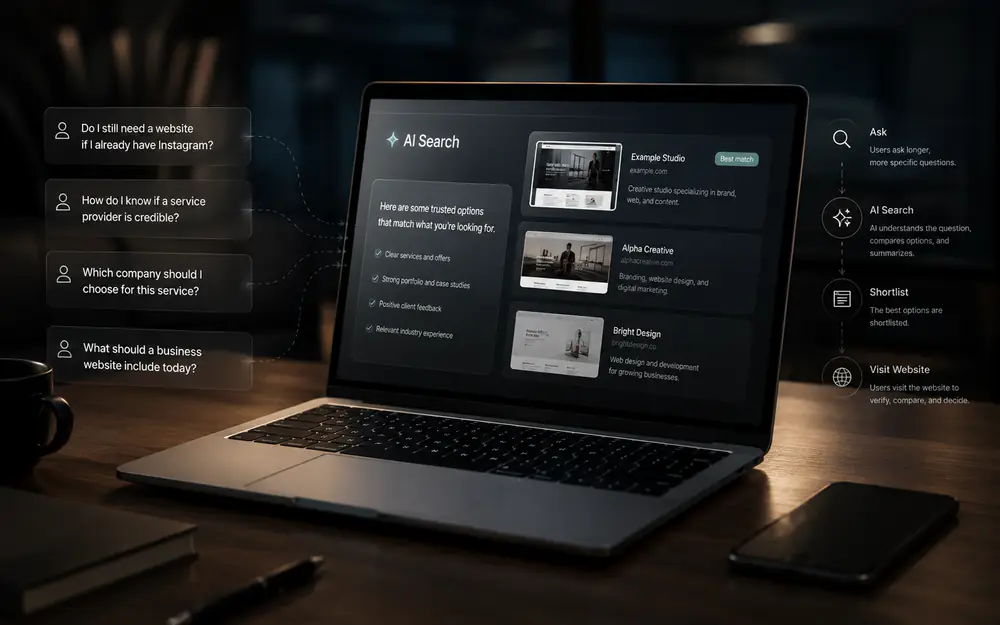
Google's guidance for generative AI Search explains that AI features in Search are still rooted in Google's core Search ranking and quality systems. Google's AI Search update also shows how search is moving toward longer, more conversational journeys.
The simple point is this: AI Search still needs clear, crawlable, useful web content.
If your brand information only lives in scattered captions, private chats, PDFs, or short videos, it becomes harder for search systems and customers to understand your business. A website gives your brand a cleaner source of truth.
Malaysia Context: Customers Judge You Across Multiple Touchpoints
In Malaysia, customers rarely judge a business from one platform only.
DataReportal's Digital 2026 Malaysia report estimated 35.4 million internet users in Malaysia at the end of 2025, with internet penetration at 98.0%. It also estimated 30.7 million active social media user identities, equivalent to 85.0% of the population.
That means your customers are already moving between platforms every day.
- They may first see you on TikTok or Instagram.
- Then they check your visuals and social proof.
- Then they search your brand on Google.
- Then they visit your website.
- Then they compare your portfolio, reviews, case studies, location, and contact path.
- Only then do they message you on WhatsApp or submit an enquiry.
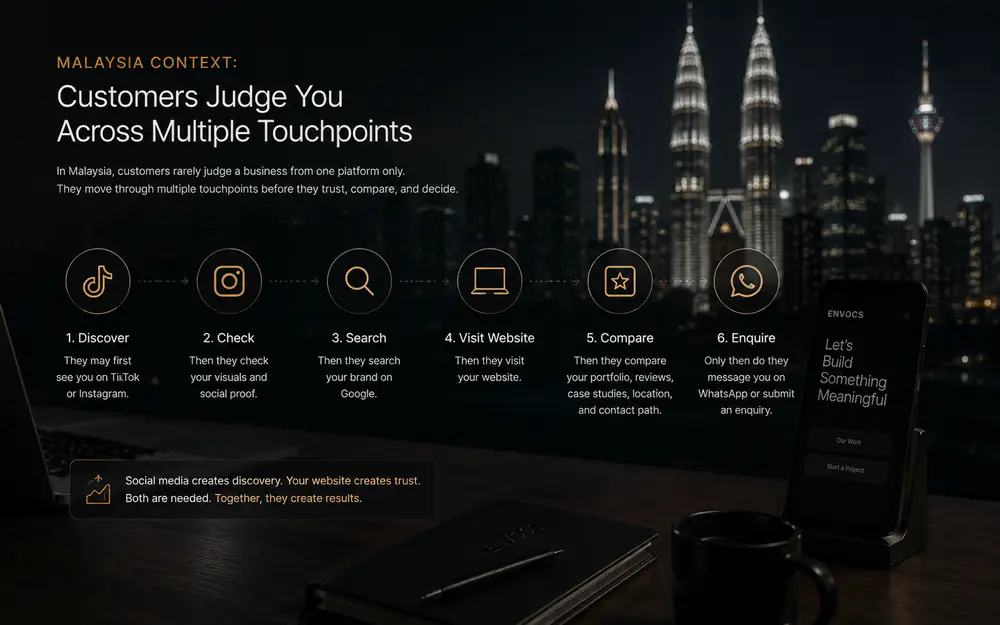
Social media matters, but it is not a complete trust system.
- Social media creates discovery.
- Your website explains capability.
- Your portfolio shows proof.
- Your FAQ reduces hesitation.
- Your contact page gives the next step.
For a low-risk impulse purchase, a social profile may be enough. For a service, project, collaboration, event, campaign, programme, or business relationship, customers usually need more context before they trust.
Social Media Is Discovery. Website Is Verification.
Social media helps people notice you. A website helps people decide whether they should trust you.
This is the gap many businesses feel but do not name clearly.
- The Instagram looks good, but the services are unclear.
- There are many posts, but no clear portfolio.
- The bio sounds interesting, but the offer is vague.
- People are interested, but they cannot find enough information to decide.
- Customers still need to ask basic questions before they enquire.
For many service businesses, one caption is not enough to explain the full offer. A serious customer may need to understand the scope, process, proof, pricing context, timeline, and whether the provider is the right fit.
That is where a website becomes useful.
A good website turns scattered attention into structured trust.
AI Search May Reduce Clicks, But It Does Not Reduce Website Value
AI summaries may reduce some traditional clicks, especially for informational searches. Pew Research Center's analysis of AI summaries and click behavior found that users clicked traditional results less often when an AI summary appeared.
That does not make websites irrelevant. It makes clarity, authority, and trust more important.
- Old website logic: "I need traffic."
- New website logic: "I need to be understood, verified, trusted, and chosen."
By the time someone clicks into your site, they may already be closer to shortlisting or enquiry. They are not only browsing. They are confirming whether you are real, relevant, and credible.
The website must help them confirm trust quickly.
Website Is Owned Media
Social platforms are useful, but they are not fully yours.
Social platforms can change:
- Algorithms can shift.
- Reach can drop.
- Account access can be restricted.
- Formats can change.
- Audience behaviour can move.
Your website gives you:
- A stable domain.
- A searchable content base.
- A clear service explanation.
- A proof archive.
- A conversion path.
This does not mean social media is less important. It means social media should not carry the whole job alone.
Social media should create attention. Your website should organize that attention into trust.
What A Strong Website Needs Now
A strong business website does not need to be complicated. But it needs to be clear in five areas:
- Clarity: Who you are, who you help, what you do, and why it matters.
- Proof: Portfolio, case studies, testimonials, reviews, or real examples that show you can deliver.
- Answers: Useful content, FAQs, service explanations, and articles that handle customer hesitation.
- Structure: Clean pages, clear headings, crawlable content, internal links, metadata, sitemap, and mobile-friendly performance.
- Action: A clear next step such as WhatsApp, enquiry form, booking link, or contact page.

Technical SEO still matters, but it works best when the business message is already clear. A technically optimized website with vague positioning is still weak.
The goal is not only to be indexed. The goal is to be understood.
Brochure Website vs Strategic Website
Many businesses do not dislike websites. They dislike weak websites that were launched once and never developed into useful digital assets.
A brochure website says:
- Here is who we are.
- Here are our services.
- Here is our contact form.
A strategic website does more:
- It explains positioning.
- It answers customer questions.
- It proves capability.
- It supports search visibility.
- It helps sales conversations.
- It gives high-intent visitors a clear next step.
The difference is not only design. The difference is whether the website helps a customer move from attention to trust to action.
The Future: Websites Built For People And AI
AI agents and AI-assisted search will not make clarity less important. They will make clarity more visible.
Someone may ask:
- "Find a suitable service provider near me."
- "Compare three vendors for this type of project."
- "Which company looks more credible?"
- "Which option fits my budget, timeline, and needs?"
If your website is unclear, AI may not understand your business properly.
- If your services are hidden inside social captions, AI may miss them.
- If your portfolio has no context, AI may not understand what your work proves.
- If your FAQ does not answer real questions, AI may not know who you are suitable for.
- If your pages are thin or vague, both people and machines have less to work with.
The future website is built for both human visitors and machine understanding.
ENVOCS Perspective
At ENVOCS, I do not see a website as just a design output. I see it as part of a wider digital presence system.
A useful website should connect:
- Brand clarity.
- Service structure.
- Proof.
- Content.
- Search readiness.
- Conversion path.
Design still matters. But the real value appears when the site helps people understand, trust, and act.
Practical Website Check
If you already have a website, start with these questions:
- Can visitors understand what you do within five seconds?
- Is it clear who your service is for?
- Do your main services have enough explanation?
- Does your portfolio show context, not just visuals?
- Do you answer the questions customers usually ask before enquiring?
- Is your brand information consistent across your website, Google, and social platforms?
- Is there a clear next step for serious visitors?
- Would Google or AI Search understand what your brand should be associated with?
These questions are simple, but they reveal most website problems quickly.
FAQ
Do businesses still need websites in the AI Search era?
Yes. AI Search changes how people find and compare information, but it does not remove the need for a stable source of truth. A website helps customers, Google, and AI Search understand what your business does and why it is credible.
If I already have Instagram, TikTok, or Facebook, do I still need a website?
Yes, especially if customers need to compare, verify, or understand your service before contacting you. Social media is strong for discovery, while a website is stronger for explanation, proof, and conversion.
Will AI Search reduce website traffic?
It may reduce some informational clicks, but that does not remove website value. It means your site has to work harder as a trust and decision layer when high-intent visitors do click through.
Can a small business start with a one-page website?
Yes. A one-page website can work if it clearly explains positioning, service, proof, answers, and the next step. It can later grow into service pages, case studies, articles, and landing pages.
What is the difference between website design and website strategy?
Website design focuses on how the site looks and feels. Website strategy focuses on what the site needs to say, how pages should be structured, what proof is needed, how search understands it, and how visitors move toward enquiry.
Final Thought
AI Search has not made websites disappear. It has made weak websites easier to ignore.
The real question is not whether websites still matter.
The real question is whether your website is clear enough for people and AI to understand, trust, and choose you.
For ENVOCS, a website is not just a page. It is the foundation layer of a long-term digital presence system.
When it has clarity, content, proof, structure, and direction, it becomes a long-term asset.
In the AI Search era, websites are not less important.
They just can no longer be decorative.
A website can no longer be decorative. It has to be clear, useful, structured, and worth trusting.