Most businesses do not have a marketing problem first. They have a clarity problem.
They are posting content, running ads, building websites, launching campaigns, and trying different ideas — but many of those decisions are made based on assumptions. Sometimes it is based on what competitors are doing. Sometimes it is based on what looks trendy. Sometimes it is based on what the business owner personally likes.
That is where marketing insights become powerful.
Marketing insights are not just numbers on a dashboard. They are the meaning behind the numbers.
Data tells you what happened. Insights help you understand why it happened, what the customer may be thinking, and what you should do next.
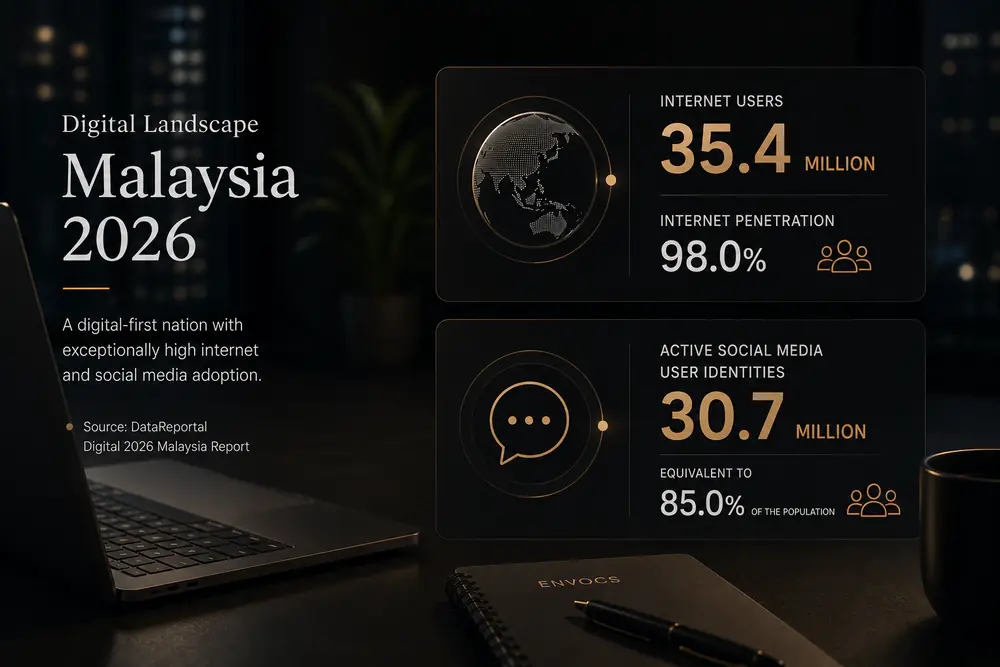
In a digital-first market like Malaysia, this matters even more. DataReportal’s Digital 2026 Malaysia report estimated 35.4 million individuals using the internet in Malaysia at the end of 2025, with internet penetration at 98.0%. It also estimated 30.7 million active social media user identities in Malaysia, equivalent to 85.0% of the population.
That means customers are already searching, scrolling, comparing, watching, clicking, saving, ignoring, enquiring, and buying online every day. That activity creates a lot of signals. But signals alone are not strategy.
The real advantage comes from knowing how to read those signals properly.
Data Is Not the Same as Insight
A lot of brands collect data, but not every brand knows how to turn data into decisions.
For example, a website may show that a blog post received 3,000 views. That is data.
An insight would sound more like this:
People are not only interested in the service itself. They are trying to understand the process before they feel confident enough to enquire.
That one insight can change how you write your landing page, how you structure your content, what kind of video you produce, and how your sales conversation should begin.
Insight: Data gives you the raw material. Insight gives you direction.
Without insight, marketing becomes random. With insight, marketing becomes sharper, more intentional, and easier to improve.
Why Marketing Insights Matter Now
The digital space is more crowded than before. AI tools have made content creation faster, but they have also made average content easier to produce. HubSpot’s 2026 State of Marketing Report describes AI as the new baseline, not the differentiator, and highlights that many marketers are already using AI for content and media production.
That means brands cannot rely on volume alone. The brands that stand out are not always the ones posting the most. They are the ones that understand their audience better and communicate with a clearer point of view.
This is also connected to personalization. McKinsey has reported that 71% of consumers expect companies to deliver personalized interactions, while 76% feel frustrated when that does not happen. In simple terms: people do not just want more marketing. They want more relevant marketing.
Marketing insights help you answer important questions:
- What does the customer actually care about?
- What problem are they trying to solve?
- What makes them hesitate?
- Which platform influences their decision?
- Which message makes them take action?
- Which part of the customer journey is weak?
When you can answer these questions, your marketing becomes less about guessing and more about building a system that learns.
1. Understanding What Customers Really Want
Many businesses make the mistake of marketing what they want to say instead of what the customer needs to hear.
A brand may want to talk about its equipment, years of experience, awards, or internal process. Those things can matter. But from the customer’s perspective, the deeper questions are usually more practical:
- Can I trust you?
- Do you understand my problem?
- Can you make this easier for me?
- Will this help my business look better, sell better, or operate better?
- Is this worth the money?
Insights help you see the difference between surface-level interest and actual buying motivation.
For example:
- If people keep clicking on pricing pages but do not enquire, the problem may not be traffic. The problem may be unclear value.
- If people watch your case study videos longer than your promotional videos, they may want proof more than persuasion.
- If customers keep asking the same questions in WhatsApp, those questions should probably become part of your website, content, or sales material.
Small signals can reveal big friction points.
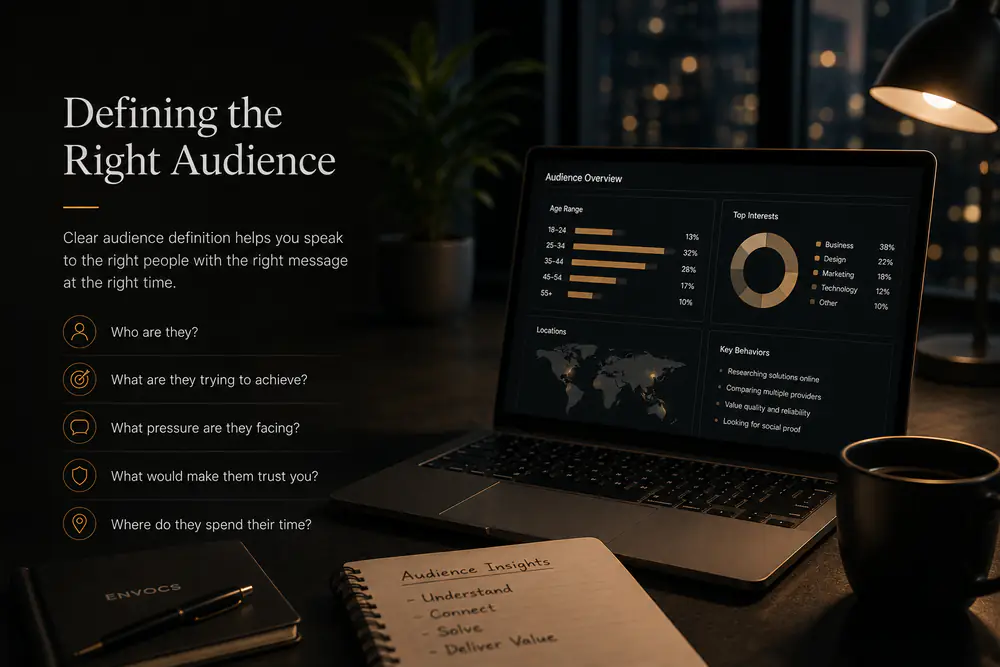
2. Defining the Right Audience
One of the fastest ways to waste marketing budget is to target “everyone”.
A clear audience is not just an age range, gender, or location. A useful audience definition includes context.
- Who are they?
- What situation are they in?
- What are they trying to achieve?
- What pressure are they facing?
- What would make them trust a provider like you?
For ENVOCS, this kind of thinking matters because creative work is not only about visuals. A video, website, campaign, or brand message only works when it connects with the right person at the right stage of their decision-making process.
For example:
- A corporate client planning an event does not think the same way as a founder launching a brand.
- A restaurant owner looking for content does not think the same way as a property developer planning a campaign.
- A startup needs clarity and momentum.
- An established company may need consistency, credibility, and execution reliability.
Marketing insights help you separate these audiences instead of forcing one message to speak to everyone.
3. Creating Campaigns With a Clearer Hypothesis
A strong campaign should not begin with “let’s just post something”.
It should begin with a hypothesis.
For example:
- We believe our audience is hesitating because they do not understand the process.
- We believe prospects need to see proof before they trust the offer.
- We believe the current message is too general and does not speak to a specific pain point.
- We believe short-form video can create awareness, but the website needs to handle conversion.
This is where insights become practical. They help you decide what to create, where to place it, and how to measure whether it worked.
A campaign without insight is just activity. A campaign with insight becomes a testable growth move.
4. Improving the Marketing Mix
The classic marketing mix — product, price, place, and promotion — still matters. But today, each part should be informed by data and customer behaviour.
- Product: not only what you sell, but how clearly the market understands the value.
- Price: not only the amount you charge, but how the customer compares your offer against alternatives.
- Place: not only where you distribute, but where your customer pays attention and makes decisions.
- Promotion: not only how you advertise, but how you translate value into a message people care about.
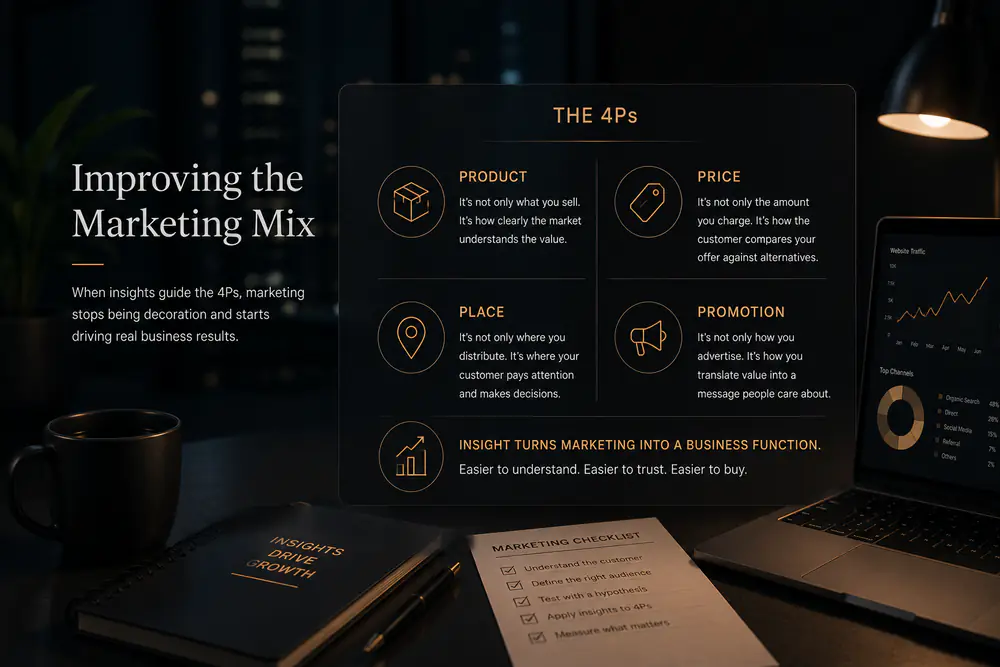
When you apply insights to the 4Ps, you stop treating marketing as decoration. You start treating it as a business function.
That shift is important. Good marketing is not only about looking professional. It is about making the business easier to understand, easier to trust, and easier to buy from.
5. Connecting Marketing to Business Results
One of the biggest issues with marketing is that people often measure the wrong things.
This is becoming more important as marketing budget continues moving into digital channels. Gartner’s 2025 CMO Spend Survey found that digital channels accounted for 61.1% of total marketing spend, which means businesses are putting serious money into platforms, campaigns, content, and performance channels that need to be measured properly.
Likes are easy to see. Reach is easy to report. Views are easy to celebrate. But those numbers do not always explain whether marketing is actually helping the business grow.
A more useful approach is to connect marketing activity to business questions:
- Which content brings the right enquiries?
- Which page helps people understand the offer?
- Which campaign attracts serious prospects instead of random attention?
- Which channel creates trust before the sales conversation?
- Which message shortens the decision-making process?
This does not mean every piece of content must directly sell. Brand awareness still matters. Trust-building still matters. Education still matters. But over time, marketing should create clearer movement: from attention, to understanding, to trust, to action.
That is the real value of insights.
How Small Businesses Can Start Gathering Insights
You do not need an expensive enterprise system to start using marketing insights.
Start simple.
Start with simple tools and lightweight tracking:
- Use Google Analytics to understand how people move through your website, which pages attract attention, where users drop off, and which sources bring better traffic.
- Use social media insights to see what content people save, share, comment on, or ignore.
- Use Search Console to understand what people are already searching before they find you.
- Track your enquiries manually if needed.
- Keep a simple spreadsheet so patterns become visible when you use it consistently.
The key is not the tool. The key is the habit.
Every week or month, ask:
- What changed?
- What pattern do we see?
- What surprised us?
- What is the customer telling us indirectly?
- What should we improve next?
For many SMEs, the most valuable insights are not hidden in complicated dashboards. They are already visible in customer questions, sales objections, website behaviour, ad performance, comments, DMs, reviews, and repeated conversations.
The problem is that most teams do not capture those signals properly.
The Human Layer Still Matters
Big data is useful, but data alone does not understand context.
A dashboard can show you that people are dropping off from a page. It cannot automatically tell you whether the headline is weak, the offer is unclear, the design feels untrustworthy, the pricing is confusing, or the audience is wrong.
That is where human judgement comes in.
Good marketing insight sits between analytics and empathy. You need the numbers, but you also need to understand people. Their hesitation. Their desire. Their fear of making the wrong choice. Their need to justify a decision. Their preference for convenience, credibility, speed, status, or safety.
This is also why AI should not replace strategic thinking. AI can help you process information faster, generate ideas, and scale execution. But the brand still needs a point of view. The business still needs a clear position. The message still needs a human reason to exist.
Salesforce’s 2026 State of Marketing research also points to this gap. Many marketers say customers now expect two-way conversations, yet many still struggle to respond quickly because they lack the right customer context. That is not only a technology issue. It is a systems issue, a data issue, and a customer understanding issue.
If everyone has access to the same tools, the difference is no longer just who can produce more content.
The difference is who can think better.
A Practical Way to Think About Insights
For me, a useful marketing insight usually has three parts:
- What is happening?
- Why might it be happening?
- What should we do about it?
For example:
- What is happening: People are visiting the service page but not submitting enquiries.
- Why it might be happening: The page explains what the service is, but not enough proof, process, pricing context, or outcome clarity is provided.
- What to do next: Add case studies, FAQs, clearer packages, stronger call-to-action sections, and a more specific explanation of who the service is for.
This is how insight turns into action.
It is not about collecting data for the sake of reporting. It is about making better decisions.
Final Thought
Marketing insights are not a trend. They are the bridge between attention and strategy.
In a market where customers are more informed, platforms are more competitive, and content is easier to produce than ever, businesses need more than activity. They need clarity.
The goal is not to become obsessed with data. The goal is to understand the market better, make sharper decisions, and build marketing that actually supports business growth.
Data tells you what happened. Insight tells you what it means. Strategy decides what to do next.
That is where better marketing begins.