Most events happen once. The room is prepared, people arrive, the moment happens, and then everything is packed away. If the event is not captured properly, much of the value disappears with it.
This is why event videography and photography should not be treated as a last-minute add-on. When done with intention, coverage turns the event into proof, content, memory, and a long-term brand asset.
The event is the moment. The content is the multiplier.
A business may spend serious time and budget on venue, production, speakers, staging, guests, and logistics. But if the event only lives for the people inside the room, the reach is limited. Good content allows the moment to keep working after the room is empty.
Event Coverage Is Not Just Documentation
Basic coverage records what happened. Strategic coverage captures why it mattered.
Basic coverage records what happened. Strategic coverage captures why it mattered.
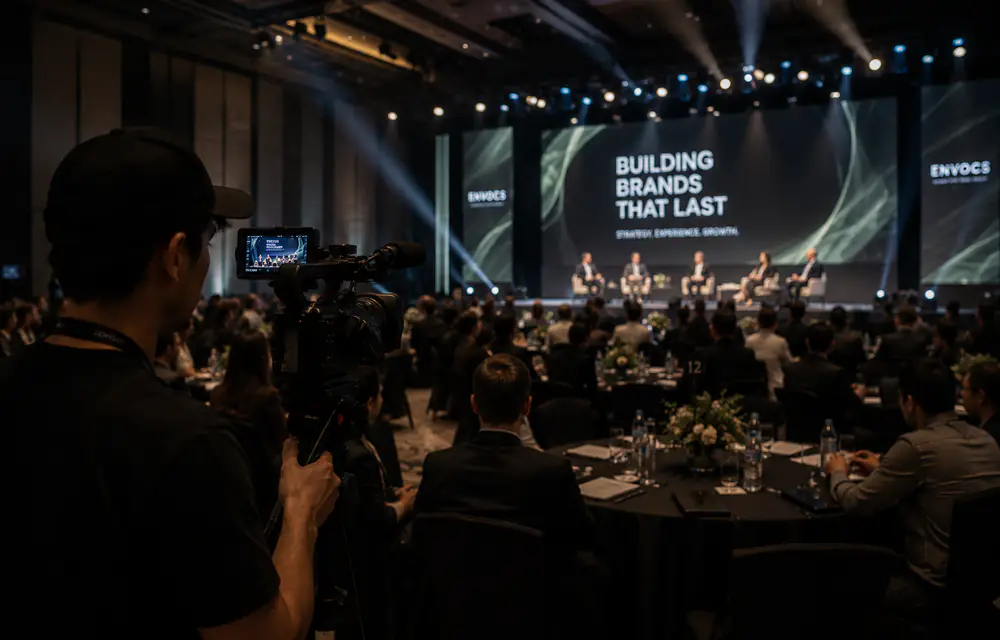
A good event team does not only point the camera at the stage. They look for the atmosphere, the reactions, the brand details, the stakeholder moments, the behind-the-scenes work, and the human signals that explain the event's meaning.
For personal events, those visuals become memory. For businesses, they become proof. They show that people attended, the brand was active, the team executed, and the event created a real-world moment worth remembering.
The strongest event coverage usually captures five things clearly:
- the people
- the energy
- the brand presence
- the proof
- the story
That proof matters because trust is no longer built only through what a brand says. It is also built through what people can see.
Why Event Content Matters More In A Digital Market
In Malaysia, an event does not stay inside the venue. It moves into Instagram, TikTok, Facebook, LinkedIn, YouTube, WhatsApp, websites, decks, proposals, recruitment content, PR, and future sales conversations.
DataReportal's Digital 2025 Malaysia report shows how deeply digital behaviour was already embedded in the Malaysian market at the start of 2025, with 34.9 million internet users, 97.7% internet penetration, and 25.1 million social media user identities representing 70.2% of the population.
The practical point is simple: the people who did not attend may still judge the event, the brand, and the credibility through the content. They may only see a LinkedIn post, a short reel, a website recap, or a few photos in a proposal. Those touchpoints shape how the event is remembered.
That is why event content should not be seen as an archive. It is part of distribution. The event may happen offline, but its business value continues online.
Photography Builds Trust Quickly
Photography is often the first proof people scan. A strong event photo can communicate scale, audience, setup quality, sponsor presence, atmosphere, and professionalism faster than a paragraph can.
For a corporate event, photos support LinkedIn posts, stakeholder updates, PR, internal reporting, and future proposals. For a product launch, photos show interaction, attention, and the environment around the product. For a community event, photos show participation and emotion.
Good photography gives people fast visual proof that the event really happened, and that it mattered.
This is not about making every event look artificially dramatic. It is about giving the brand a clear visual record that feels credible, human, and useful.
Video Extends The Life Of The Event
Photos freeze the moment. Video brings back movement, voice, pacing, sound, and emotion.
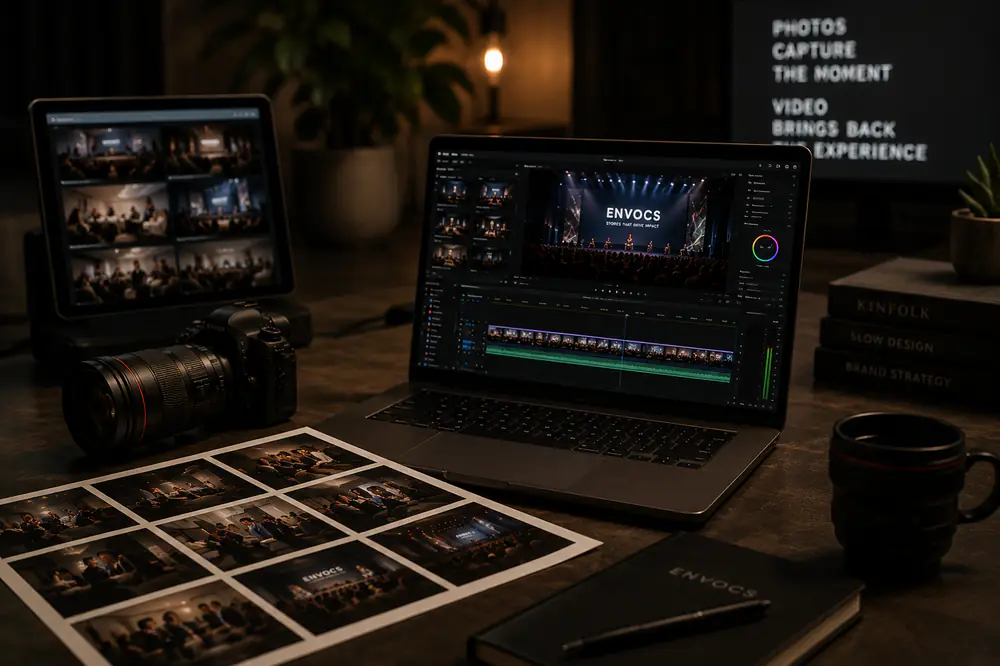
A good event video helps people who were not there understand the energy. It helps people who attended relive the moment. It helps the brand show momentum in a way that still images cannot fully carry.
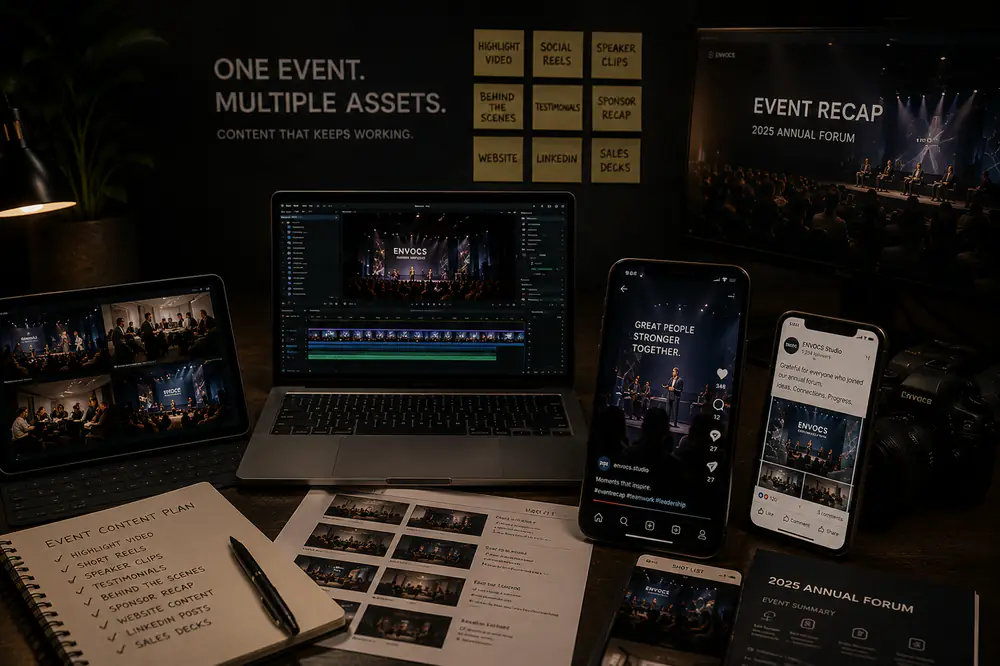
One event can become a highlight video, short social clips, speaker moments, behind-the-scenes content, testimonials, website visuals, and sales material. The value is not only one final recap. The value is the number of useful assets the event can create when it is captured with purpose.
HubSpot's 2025 video marketing statistics describe video as a strong storytelling format for communicating a brand story, value proposition, and customer relationship. That matters for events because the live moment already has story, people, and emotion inside it. The job is to capture those signals properly.
The Real ROI Is Repurposing
The biggest mistake is thinking the business is only paying for one video or one photo album. A well-captured event creates a content inventory.
Cvent's 2025 event marketing trends make a similar point by highlighting event content as fuel for year-round campaigns. That is the right lens. The event is not only a date in the calendar. It can become a source of content that supports the brand long after the day ends.
A single event can support:
- social media content
- website credibility
- LinkedIn or stakeholder updates
- sales or sponsor materials
- future event promotion
When one event becomes many useful assets, the cost of coverage starts to make much more business sense.
This is especially useful for businesses that struggle to post consistently or explain what they do with enough proof. A real event gives the brand substance to work with.
Real Events Create Trust That Digital Alone Cannot
Digital content can be polished, scheduled, boosted, and even AI-generated. Real events show something different: presence.
They show people gathering. They show interaction. They show a brand doing something in the real world. For service businesses, corporate brands, community builders, and B2B teams, this kind of proof is hard to fake.
The event builds trust in the room. The content extends that trust beyond the room.
This is why event content has value beyond aesthetics. It gives future customers, partners, employees, sponsors, and stakeholders a way to see that the brand is active, capable, and real.
Quality Shapes Brand Perception
Bad visuals can make a good event look average. Many people will only experience the event through the photos and videos. If the content is messy, shaky, poorly composed, or badly edited, the digital memory becomes weaker than the actual event.
The standard does not need to be overproduced. It needs to feel intentional, clear, stable, well-composed, and aligned with the brand.
- A premium brand should not look careless.
- A corporate event should not feel messy.
- A community event should not lose its human emotion.
- A product launch should make the product feel desirable and clear.
Visual quality becomes part of the brand signal. It tells people whether the business respects the moment it created.
Coverage Becomes Stronger When It Starts Before The Event
Many businesses bring in the videographer or photographer too late. They send the schedule and expect the team to capture everything. That can work for documentation, but it rarely produces the most useful assets.
Before the event, the business should be clear about a few things:
- What is the main story we want people to remember?
- Which moments matter most?
- Who must be captured?
- Where will the content be used after the event?
- Do we need horizontal video, vertical clips, photos, soundbites, or all of them?
The earlier the coverage is planned, the more useful the final assets become.
Once these answers are clear, the production team can capture with purpose. That is the difference between having footage and having assets.
What Businesses Should Capture
A strong event coverage plan should capture the environment, people, key moments, proof of value, and repurposing material.
- Environment: venue, signage, branding, entrance, stage, booths, product displays, and details that show the event setting.
- People: guests arriving, networking, listening, reacting, interacting, and participating.
- Key moments: speeches, launches, panels, awards, group photos, VIP moments, and important transitions.
- Proof of value: testimonials, audience reactions, sponsor presence, media attendance, product usage, and meaningful interactions.
- Repurposing material: vertical clips, B-roll, behind-the-scenes footage, speaker snippets, team moments, and short-form social content.
This keeps the coverage practical. The goal is not to capture everything randomly. The goal is to capture what will still be useful later.
When Professional Event Coverage Is Worth It
Professional coverage is especially worth it when the event has value beyond the day itself.
- product launches
- grand openings
- conferences
- seminars or workshops
- brand activations
- annual dinners
- milestone celebrations
If the event matters to your brand, team, customers, stakeholders, or future marketing, coverage is not just a cost. It is part of the event investment.
If the event matters to the business, the content should be planned as part of the event investment.
That does not mean every small gathering needs a full production team. It means the level of coverage should match the business value of the event.
A Practical Way To Think About Event Content
For me, the simplest way to think about event content is this: the event is the moment, but the content is the multiplier.
If the event only exists for people in the room, the reach is limited. If it is captured properly, it can keep supporting trust, content, sales, recruitment, and brand perception long after the room is empty.
This is the real business case. Good event content gives the brand more than memories. It gives the business reusable proof.
FAQ
Is event videography and photography worth it for business events?
Yes, if the event has value beyond the day itself. Good coverage turns the event into proof, content, and future marketing material.
Should an event have both photography and video?
Usually, yes. Photography gives fast visual proof, while video carries movement, voice, atmosphere, and emotion. They support different uses.
What should businesses prepare before event coverage?
Prepare the event schedule, key people, important moments, brand priorities, and where the content will be used after the event.
How can one event become multiple content assets?
A single event can become social posts, short clips, website visuals, stakeholder updates, proposal material, recruitment content, and future event promotion.
When should event coverage be planned?
Plan it before the event, not after the schedule is already fixed. Early planning helps the team capture the right story and the right assets.
Final Thought
Event videography and photography are not just about having nice photos or a recap video. They preserve attention, emotion, proof, and trust.
A good event should not disappear after the guests leave. If it is captured well, it can continue working through content, communication, sales, recruitment, and brand perception.
A good event happens once. Strong event content keeps the value moving after the room is empty.