SEO is not dead. It has expanded.
For a long time, many people used SEO to mean one thing: getting to page one of Google. That still matters, but it is no longer the full picture. Customers now ask AI tools, search TikTok, watch YouTube, compare Instagram profiles, read websites, check reviews, and decide whether a brand feels credible before they enquire.
In that environment, search visibility is no longer only about ranking for keywords. It is about whether a customer, search engine, or AI system can understand who you are, what you do, why you are credible, and whether you are worth recommending.
Search visibility is no longer just about ranking. It is about being found, understood, trusted, and remembered across the places customers now search.
SEO still matters. AEO and GEO simply describe two newer layers of the same visibility problem. SEO helps brands get found. AEO helps content become the answer. GEO helps AI systems understand, cite, mention, or recommend the brand more accurately.
The real goal is not chasing acronyms. The real goal is clarity, trust, useful content, proof, and digital structure.
Why This Topic Matters Now
Many business owners are producing content, posting on social media, maybe even running a website, but still feel unsure whether all of this activity is making the brand more visible.
- Some brands get traffic but no enquiries.
- Some have active social media but weak trust.
- Some have a website that looks fine but explains too little.
- Some hear AEO, GEO, and AI Search and feel like SEO has changed overnight.
The good news is that the foundation has not disappeared. The language has changed, but the question is still simple: when customers are searching, comparing, or asking AI for help, can your brand be understood as a credible answer?
Google's guidance for generative AI Search says Google's AI features in Search are still rooted in its core Search ranking and quality systems. In plain English, useful content, clear structure, and real value still matter. AI Search does not remove the need for good SEO. It raises the standard for clarity.
Search Visibility Is No Longer Only Google
In Malaysia, customers often move through several touchpoints before enquiring. They may discover a brand on TikTok, check Instagram, search Google, visit the website, look for proof, and then WhatsApp.
DataReportal's Digital 2026 Malaysia report reported 35.4 million internet users in Malaysia at the end of 2025, with 98.0% internet penetration, and 30.7 million social media user identities in October 2025. Those numbers help explain why customers rarely judge a brand from one channel only.
- Google helps people search with intent.
- Social media helps people judge activity and personality.
- YouTube and TikTok help people learn visually.
- Websites help people verify credibility.
- AI tools help people compare and summarize options.

That is why search visibility is now a digital presence system, not only an SEO task.
If your brand is unclear across platforms, both people and AI systems will struggle to understand why you should be trusted.
SEO, AEO and GEO in Simple Terms
SEO — Search Engine Optimization SEO helps search engines crawl, index, understand, and rank your pages. Google's SEO Starter Guide frames SEO as work that helps search engines understand content and helps people decide whether to visit from search results.
AEO — Answer Engine Optimization AEO helps your content become a clear answer to a specific question. If someone asks what AEO means, the article should answer early, then explain the context. Semrush's explanation of AEO describes the practice around improving visibility in AI-generated answers, but the principle is simpler: make useful answers easy to find.
GEO — Generative Engine Optimization GEO helps generative AI systems understand, cite, mention, or recommend your brand more accurately. The GEO research paper formalized the idea of optimizing content for generative engines that synthesize answers from multiple sources.
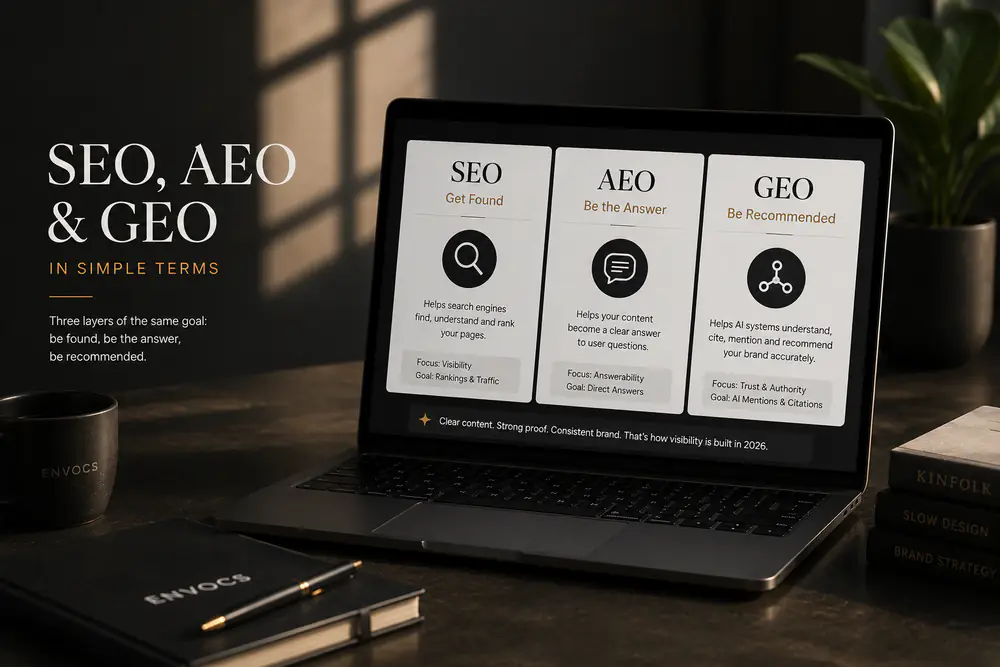
These are not three separate worlds. They are three layers of the same visibility problem. A customer wants an answer. A search engine wants useful pages. An AI system wants reliable context. Your brand needs enough clarity, structure, and proof to be understood by all three.
SEO gets you found. AEO helps you become the answer. GEO helps AI understand and recommend you accurately.
The Difference Between SEO, AEO and GEO
The comparison can be simple. You do not need to memorize every new term. You need to know what job each layer performs.
| Layer | Main Question | Best Content Type |
|---|---|---|
| SEO | Can people find us through search? | Service pages, articles, guides, landing pages |
| AEO | Can our content answer the question clearly? | FAQs, direct answers, comparisons, steps |
| GEO | Can AI understand and cite us accurately? | Case studies, clear brand info, original POV, credible sources |
Do not treat this as a buzzword race. A weak website does not become strong because you call it GEO. Generic content does not become trustworthy because it mentions AI Search. The basics still matter.
What Brands Should Do First
The first priority is to make the website clear before making it bigger. A brand website should make it obvious who the brand helps, what it provides, what proof exists, and what the next step is. If those basics are unclear, more content and more channels will only spread the confusion.
Google Search Essentials covers the technical requirements and policies that help sites appear in Google Search. For a business owner, the practical translation is this: make the site crawlable, indexable, mobile-friendly, and easy to understand. Technical SEO works best when the business message is already clear.
The second priority is to answer real customer questions. Answer-first writing is not about making articles robotic. It is about respecting the reader. If the title asks a question, answer it early, then expand with context, examples, proof, and nuance.
The third priority is to build content clusters, not random posts. A single article can be useful, but related articles help humans, Google, and AI systems understand the brand's topic area. For example, a brand that works around digital presence might publish connected articles about websites, SEO, social media, AI Search, content systems, case studies, and conversion.
The fourth priority is to add real experience and proof. AI can generate generic explanations, but it cannot replace real projects, judgment, case studies, client questions, visual examples, founder perspective, and lessons from actual work. That is where a brand earns trust.
The fifth priority is to keep the brand entity consistent. The website, Google Business Profile, social profiles, LinkedIn, portfolio, articles, and contact details should describe the brand in a consistent way. If every platform explains the business differently, both customers and AI systems will have a harder time understanding it.
Google's structured data documentation is useful here because structured data helps Google understand page content and entities more clearly. But schema is not a magic button. It supports real content; it does not replace clarity.
Do Not Chase AI Search Hacks
The market will keep producing "AI SEO hacks," "GEO tricks," and shortcut tactics. Some will sound smart. Most brands do not need to start there.
The sustainable approach is:
- Write for real customers.
- Structure content clearly.
- Use credible sources.
- Show real experience.
- Keep technical hygiene clean.
- Make the brand easier to understand.
Do not write for bots. Write for real customers, then structure the content so machines can understand it.
Good SEO in the AI era is not about tricking machines. It is about making your brand easier to trust, easier to interpret, and easier to recommend when the answer genuinely fits.
ENVOCS Perspective: Search Visibility Is a Trust System
At ENVOCS, I see search visibility as part of a wider digital presence system, not just a keyword exercise. SEO, AEO, and GEO should not be treated as three disconnected projects. They are different layers of the same trust system.
A website explains the brand. Content answers questions. Visuals and case studies create proof. Social media distributes ideas. Technical structure helps search engines and AI systems understand the content. Measurement shows whether visibility is turning into better enquiries.
- Website explains.
- Content educates.
- Visual proof builds trust.
- Social media distributes.
- SEO helps people find.
- AEO helps content answer.
- GEO helps AI understand.

A strong digital presence connects these layers instead of treating every channel as a separate task.
Search visibility in 2026 is not only technical. It is a trust system built from clarity, content, proof, structure, and consistency.
Practical Steps For Brands
For business owners, creators, startups, and brand teams, I would keep the practical work focused.
- Clarify your core services and positioning. Make it obvious who you help, what you do, and why the work matters.
- Make each important service page clear and useful. Explain the service, the audience, the process, the proof, and the next step.
- Write answer-first articles around real customer questions. Answer the question early, then expand with examples and context.
- Add proof through case studies, visuals, testimonials, or project context. Let customers and search systems see evidence, not only claims.
- Keep brand information consistent across website, Google, and social platforms. Make the brand entity easier to recognize.
- Use technical basics such as titles, metadata, sitemap, schema, alt text, and mobile performance. Keep the structure clean enough for machines and humans.
- Track visibility by looking at enquiries, branded search, search impressions, AI mentions, and conversion quality. Do not judge visibility by traffic alone.
This is less exciting than chasing hacks, but it is more durable. Strong visibility compounds when the brand keeps becoming clearer.
FAQ
Is SEO still important in 2026?
Yes. SEO is still important because search engines and AI Search features still depend on useful, crawlable, high-quality content. What has changed is that SEO now sits inside a wider visibility system that includes answers, AI summaries, social proof, and brand trust.
What is the difference between SEO, AEO and GEO?
SEO helps people find your pages through search. AEO helps your content answer specific questions clearly. GEO helps generative AI systems understand, cite, mention, or recommend your brand more accurately.
Does every brand need GEO?
Every serious brand should care about being understood by AI systems, but GEO does not need to be treated as a separate department. Start with clear website content, consistent brand information, real proof, and useful answers.
Can AI-generated content help SEO?
AI can help with research, outlining, and content preparation, but it should not replace real experience or quality control. Generic AI content without original value will not build a strong brand presence.
What should brands focus on first?
Start with clarity. Make the website useful, answer real customer questions, add proof, keep brand information consistent, and then improve technical structure.
Final Thought
SEO, AEO, and GEO are not three separate buzzwords to chase. They are three ways of asking the same question: can your brand be found, understood, trusted, and recommended when someone is looking for an answer?
- SEO helps people find you.
- AEO helps your content become the answer.
- GEO helps AI understand and cite you accurately.
The brands that win search visibility in 2026 will not be the ones chasing every new acronym. They will be the ones with clearer websites, stronger proof, better answers, more consistent brand information, and a digital presence that is useful to both people and machines.
Search visibility is no longer just a ranking game. It is a clarity and trust game.