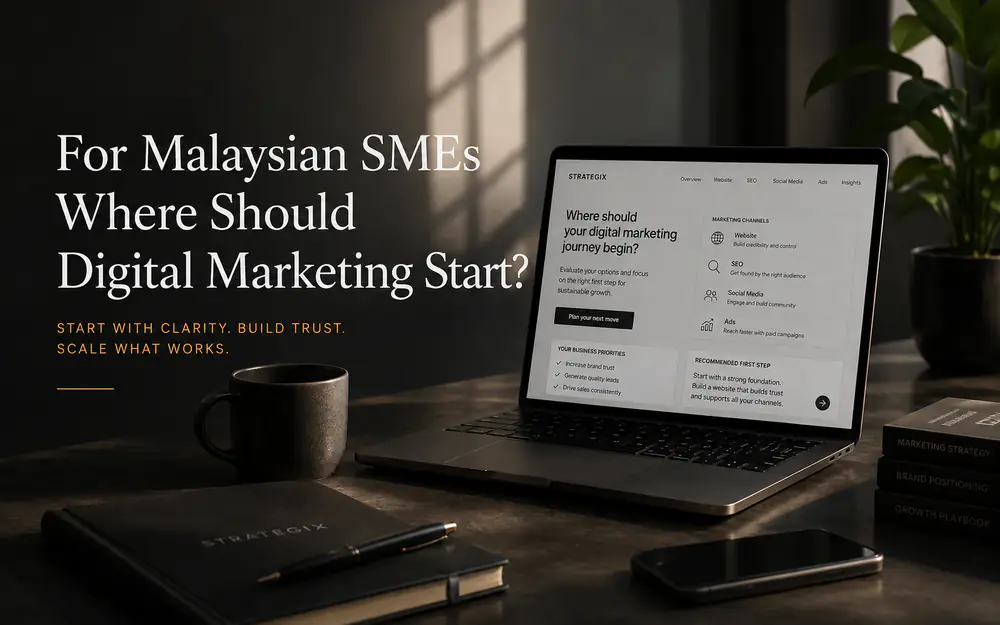
Many SMEs ask the same question when they start taking digital marketing seriously: should they build a website first, start SEO, post more on social media, or run ads?
It is a practical question, but it can also send the business in the wrong direction. When you start by choosing a channel, every platform sounds urgent. The better starting point is to look at the customer journey and ask where people are getting stuck.
- If people do not know you exist, you need visibility.
- If people know you but do not trust you, you need proof and positioning.
- If people are interested but do not enquire, you need conversion clarity.
- If people already enquire and buy, SEO and ads can help scale what is working.
Do not start with the channel. Start with the missing part of the customer journey.
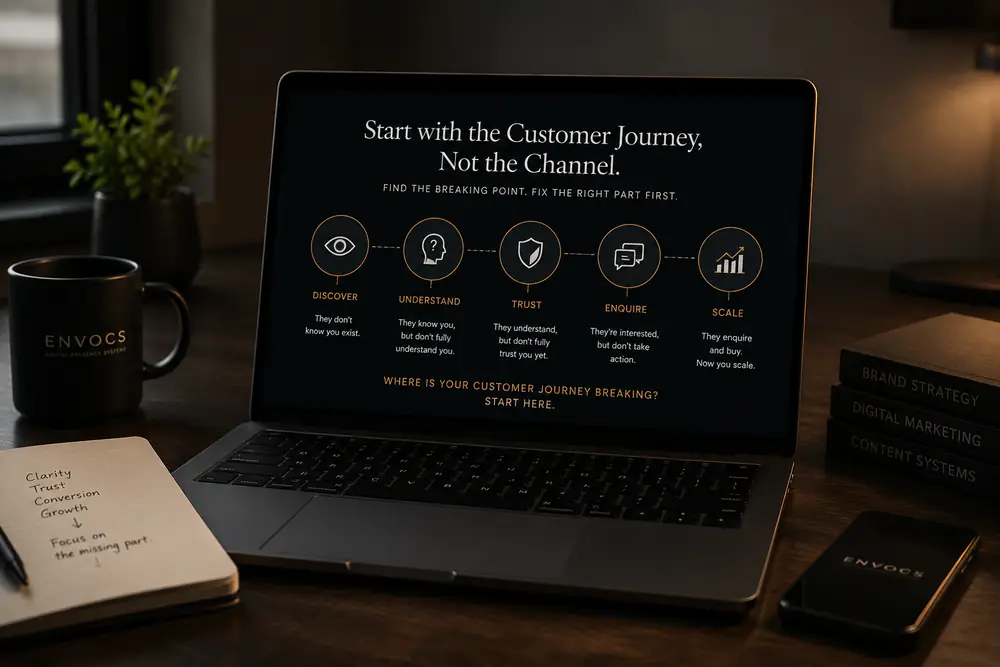
For Malaysian SMEs, digital marketing should not feel like guessing which platform is popular this month. It should help customers discover, understand, trust, compare, and contact the business with less friction.
The Common Mistake: Starting From the Outer Layer
Many SMEs begin with the most visible marketing activity: running ads, posting more content, shooting videos, redesigning visuals, hiring social media management, or launching promotions.
These activities are not wrong. The problem is doing them before the offer, proof, website or landing page, and enquiry path are clear. If the customer does not understand what you do, why it matters, why you are credible, or what to do next, more activity will not fix the problem. It will only make the weakness louder.
Reach without trust becomes noise. Traffic without conversion becomes waste.
The Four Jobs of Digital Marketing
Website, SEO, Social Media, and Ads are not the same tool. They do different jobs inside the same customer journey.
- Website: Trust and conversion centre.
- SEO: Long-term search visibility.
- Social Media: Visibility, relationship, and memory.
- Ads: Testing and scaling accelerator.
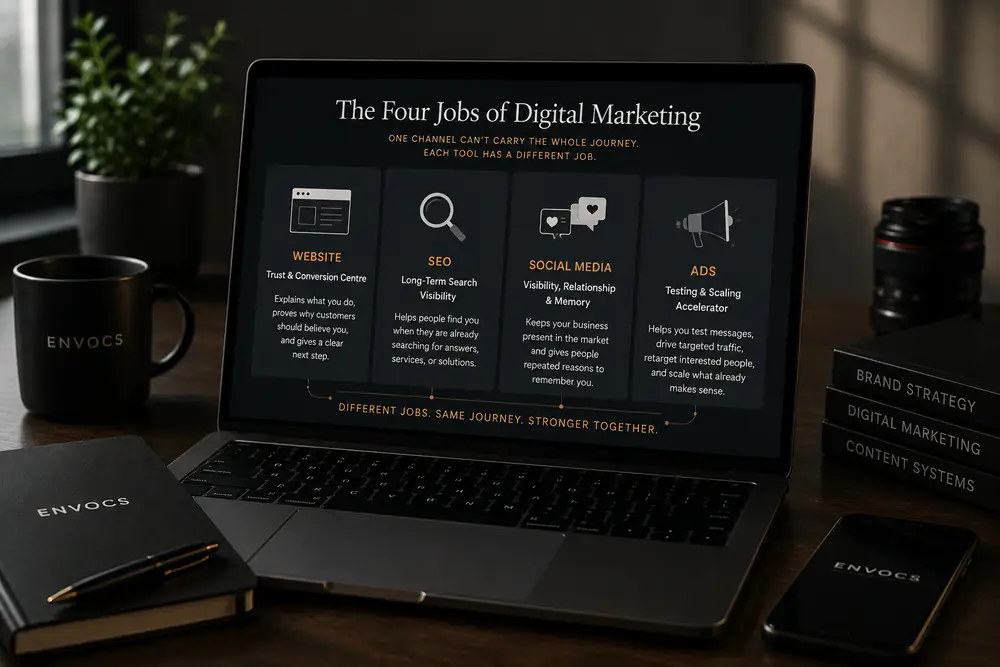
One channel cannot carry the whole journey by itself. A website without visibility may sit quietly. Social media without a clear offer may get attention but not trust. SEO without structure takes longer than it should. Ads without clarity can spend money quickly without improving the business.
That is why the question is not which channel is best. The better question is which role is currently missing.
So What Should SMEs Do First?
The first move depends on the weakest point in the journey. A business with no awareness has a different problem from a business with traffic but no enquiries.
- Visibility problem: Social content, Google Business Profile, and light awareness.
- Trust problem: Proof, positioning, and a clearer website or landing page.
- Conversion problem: CTA, service page, FAQ, WhatsApp path, and contact path.
- Scale problem: SEO, ads, retargeting, and landing page tests.
The right starting point is not the trendiest platform. It is the weakest part of your customer journey.
This is the clearest way to avoid random marketing activity. You are not only asking, "What should I post?" You are asking, "What does the customer need next before they feel ready to move?"
Stage 1: No Clear Online Base Yet
Some SMEs only have a Facebook page, an Instagram profile, WhatsApp conversations, and referrals. That can work for a while, but it is fragile when customers want to compare.
At this stage, the priority is not to look big. The priority is to become understandable and contactable.
- Simple website or landing page.
- Google Business Profile.
- Social profile cleanup.
- Basic proof.
- WhatsApp or contact path.
The website can be simple. The content can be simple. What matters is that a serious customer can quickly understand who you help, what you offer, why you can be trusted, and how to contact you. At this stage, clarity matters more than complexity.
Stage 2: Website Exists, But Nobody Finds It
If the website exists but almost nobody visits, the problem is distribution. A website with no visibility is like a shop with no road leading to it. The business may be prepared, but customers still need a way to find it.
This is where content, search, and social media become useful. The business needs more touchpoints that help people discover, remember, and understand it.
- SEO service pages.
- Useful blog articles.
- Google Business Profile updates.
- Social media content.
- Case studies.
A strong article can later become a carousel, short video script, sales explanation, FAQ answer, or client education material. Content should not live in one place only. It should become multiple touchpoints that help people understand the same idea from different angles.
Stage 3: People Visit, But Do Not Enquire
If there is traffic but no enquiry, do not immediately add more traffic. First, check whether the page is clear enough to convert. Sometimes visitors are not rejecting the business. They are simply not confident enough to take the next step.
- Headline.
- Offer.
- Proof.
- CTA.
- FAQ.
- Contact path.
- Mobile experience.
If visitors are already arriving but not acting, the problem may not be visibility. It may be hesitation. The page needs to reduce uncertainty and make the next step feel obvious.
If conversion is weak, more traffic only creates more waste.
Stage 4: The Foundation Works, Now You Can Scale
Ads become much more useful when the offer, landing page, proof, tracking, and sales process are already clear.
At this stage, ads can help with sharper testing and faster growth. Google Search Ads can capture high-intent demand. Meta retargeting can bring interested people back. Case study ads, video ads, and landing page tests can help sharpen the message.
Ads are not a rescue tool. They are an accelerator. They work best when they send attention into a system that already has clarity.
Use ads to test and scale. Do not use ads to hide a weak foundation.
A Simple Channel Priority Table
If you need a simple way to think about the sequence, this table is enough. It is not a fixed rule for every business, but it helps avoid starting from the wrong layer.
| Channel | Best For | Weakness | Start When |
|---|---|---|---|
| Website | Trust, explanation, conversion | Needs clarity and maintenance | Early, once the offer is defined |
| SEO | Long-term search intent | Slow | After website structure is clear |
| Social Media | Visibility and relationship | Algorithm-dependent | Early, but with content pillars |
| Ads | Fast testing and scaling | Wastes money if unclear | After offer and landing page are ready |
The sequence can change by business model, but the principle stays the same. Build the part that removes the biggest customer hesitation first.
If Budget Is Limited
Limited budget does not mean doing everything badly. It means choosing the right order.
For a small budget, start with the basics: a simple website or landing page, Google Business Profile, basic content pillars, and a small monthly content rhythm. If you test ads, keep the budget small and use it to learn, not to force growth.
For a medium budget, improve the website, publish useful SEO articles, build a more consistent social content system, and add basic tracking. Ads can enter the system once the landing page and offer are clear enough.
For a higher budget, the work becomes more integrated. Website optimization, SEO content, short-form video, Google and Meta ads, retargeting, analytics, and conversion testing can start working together. But the order still matters.
No matter the budget, the sequence is the same.
- Build trust.
- Create visibility.
- Improve conversion.
- Scale what works.
Founder Perspective: Most SMEs Chase Traffic Too Early
Many SMEs think they have a traffic problem, but when you look closer, the problem is often clarity. The offer is not specific enough. The website does not explain the value. The Instagram looks active but does not create trust. The portfolio shows visuals but gives no context. The enquiry path is weak.
Website, SEO, Social Media, Ads, and Content should work as one system.
- Website explains and converts.
- SEO helps people find you.
- Social media keeps you visible.
- Ads test and scale.
- Content connects everything.
Most SMEs do not need more random marketing activity. They need a clearer system.
Practical Recommendation: A Stable SME Digital Marketing Sequence
If I had to simplify the sequence for most Malaysian SMEs, I would keep it steady and practical.
- Clarify your positioning and offer. Know who you help, what problem you solve, and why customers should care.
- Build a clear website or landing page. Give serious visitors one stable place to understand, verify, and contact you.
- Clean up your social media profile. Make the bio, highlights, pinned posts, visuals, and contact path easy to understand.
- Create a simple content system. Build content around customer questions, proof, process, opinions, and clear offers.
- Build basic SEO around real customer questions. Start with service pages and articles that answer what people search before they buy.
- Test ads with a small budget. Use ads to test messages, audiences, and landing pages after the foundation is clear.
- Track, learn, and improve. Watch enquiries, conversion, customer questions, and sales quality, then improve the weak point.
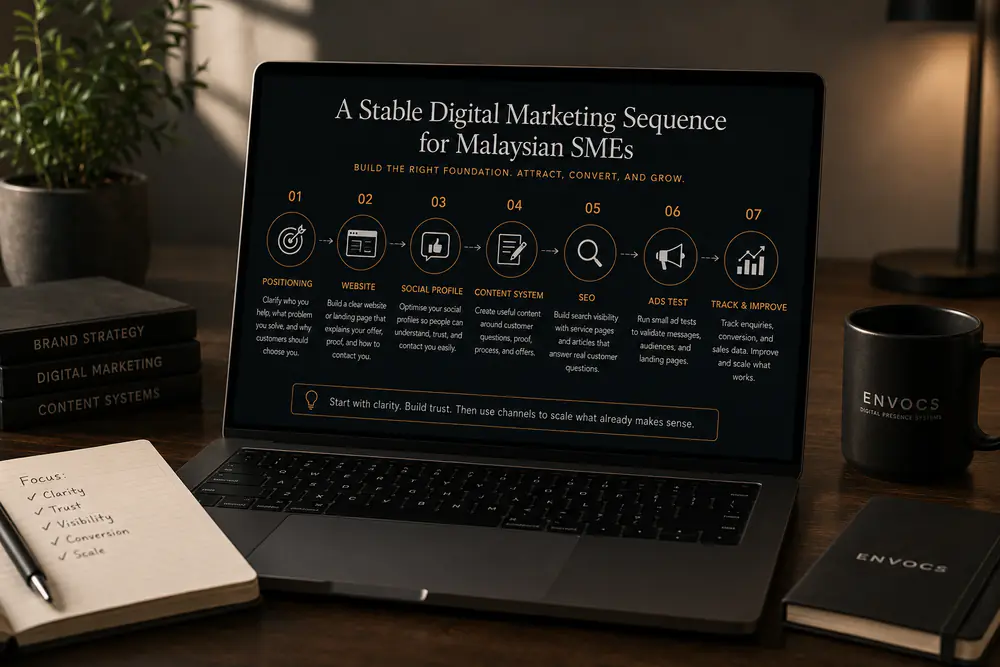
This sequence is not flashy, but it is stable. It helps SMEs build marketing that compounds instead of restarting every month.
FAQ
Does every SME need a website?
Not every SME needs a large website immediately, but most serious SMEs need a clear digital base. A simple website or landing page can help customers understand what you do, verify your proof, and contact you without relying only on social media.
Should SMEs focus on social media or website first?
If nobody understands your offer, fix the website or landing page first. If the offer is clear but nobody knows you exist, social media can help build visibility. The right answer depends on where the customer journey is weakest.
Is SEO still useful for Malaysian SMEs?
Yes, but SEO works best after the website structure is clear. It is strongest when your pages and articles answer real customer questions, not generic topics.
When should SMEs start running ads?
Start ads when your offer, landing page, proof, CTA, and follow-up process are clear enough to handle traffic. Ads can test and scale quickly, but they can also expose weak foundations quickly.
What should SMEs do if the budget is limited?
Start with clarity, a simple website or landing page, Google Business Profile, basic content pillars, and a small test budget. Avoid spreading the budget across too many channels before the foundation works.
Final Thought
Digital marketing is not about choosing one platform and hoping it works. Customers do not move from stranger to buyer in one jump. They first discover you, then try to understand you, then decide whether they trust you, then compare you with alternatives, then contact you, and only then decide whether to buy.
For Malaysian SMEs, the most practical strategy is not to chase every new platform. It is to build a clear digital foundation, create visibility around it, improve conversion, and then scale what works.
Start with clarity. Build trust. Then use channels to scale what already makes sense.