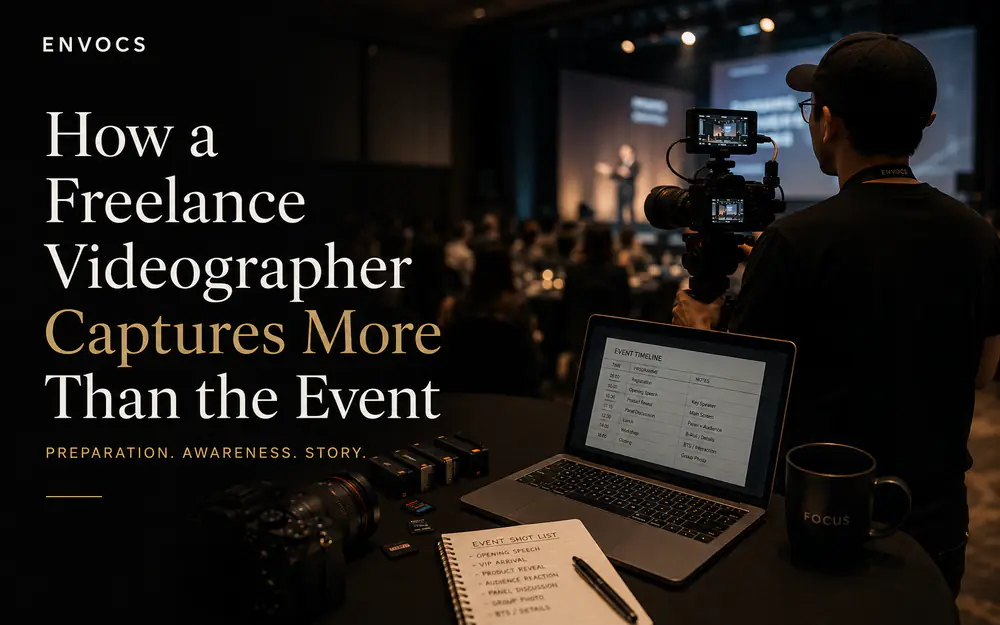
A freelance videographer is not just someone who turns up with a camera. At least, not a good one.
Event work is live. Schedules shift, lighting changes, people move, speakers run overtime, and the best moments often happen once. If you miss the applause, the reaction, the handshake, the quiet laugh, or the emotional pause, you cannot ask the room to repeat it with the same feeling.
That is why event videography is not only a technical service. It requires preparation, awareness, instinct, communication, and the ability to turn live moments into a story that still makes sense after the event is over.
A freelancer’s lens should not just capture what happened. It should capture why the moment mattered.
The right freelancer is valuable because they stay close to the work. The same person may speak to the client, understand the brief, prepare the gear, read the room, shoot the key moments, edit the story, and take responsibility for the final piece. That owner-operator mindset can make the work feel more personal, more accountable, and more focused.
Freelance Does Not Mean Amateur
Freelance means independent. It should not mean careless.
A serious freelancer can work lean and still be structured. They can move quickly and still think clearly. They can bring flexibility without turning the job into guesswork. For event coverage, that matters because the work is built on trust. The client needs to know that the person behind the camera can prepare properly, behave professionally, adapt on the ground, and deliver something useful after the event.
Freelance should not mean casual. It should mean lean, accountable, and close to the work.
This is the difference between hiring someone who only records and hiring someone who understands the responsibility of the event. A freelance videographer may not bring the scale of a large production team, but the right one can bring judgment, ownership, and direct communication.
The Real Work Starts Before The Event
Good event videos start before the camera is switched on.
A freelancer often handles the conversation, planning, gear, shooting, and editing more directly. That makes preparation important. The videographer needs to understand what the client wants the event to communicate, not only what time the event starts.
Before the event, the most useful questions are simple:
- What is the purpose of the event?
- Who is the video for?
- Which moments are non-negotiable?
- Where will the content be used after the event?
- What final outputs are needed?
The same event can be captured very differently depending on the goal. A memory-focused video, a marketing recap, a stakeholder update, a recruitment asset, and a sales-support video all need different choices on the day.
The clearer the purpose, the stronger the footage.
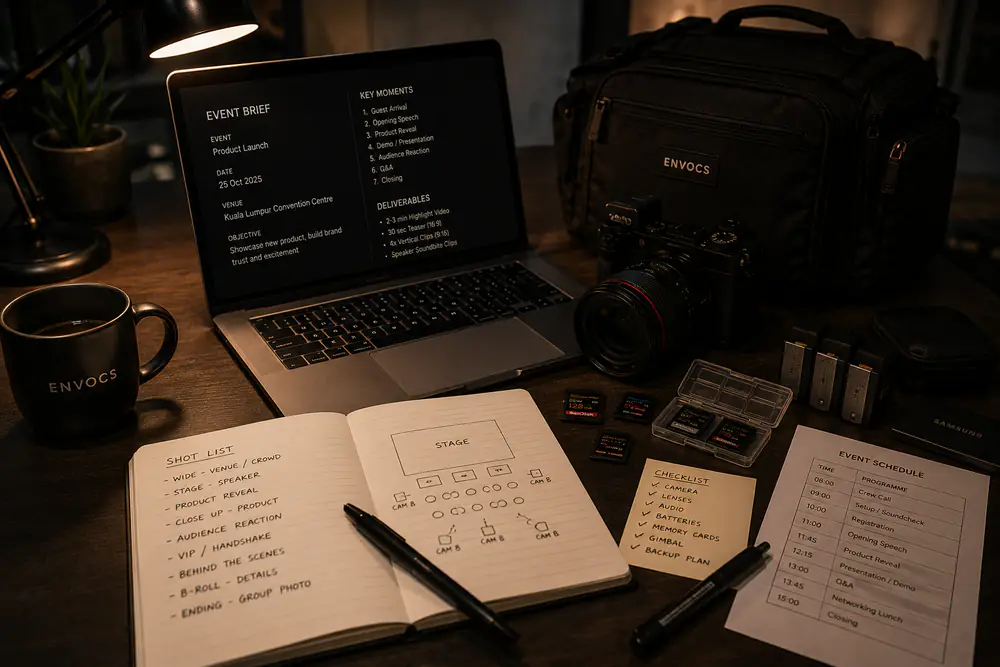
When the purpose is vague, the videographer can only react. When the purpose is clear, they can make better decisions before the moment happens.
Preparation Is Also Risk Management
Event videography leaves very little room for careless mistakes. Batteries fail. Audio can distort. Memory cards fill up. Access can be restricted. A speaker can move away from the podium. A key moment can happen earlier than expected.
The client may never see this preparation, but they feel the difference when the shoot runs smoothly. A serious freelancer checks gear, batteries, storage, audio, backup plans, schedule, contact person, venue access, and timing before arriving.
Creativity is easier when the operational foundation is stable.
The point is not to make the process complicated. The point is to protect the story. If the basics are handled properly, the videographer has more attention available for the room, the people, and the moments that actually matter.
On The Day: Blend In, But Stay Alert
On the event day, the videographer needs to be present without becoming the centre of attention.
They have to move quietly, respect the flow, avoid blocking guests, and still stay alert enough to catch what matters. This is where instinct becomes important. A good videographer reads the room. They notice where the energy is building, who is reacting, when a transition is coming, and which quiet moment may say more than the loud one.
A camera can record everything. A videographer decides what matters.
This is the difference between basic recording and event storytelling. The camera sees what is in front of it. The person behind the camera decides what deserves attention.
Mobility Is The Freelancer’s Advantage
A freelancer or small team can be limited in scale, but that same setup can also be an advantage.
Small teams can move faster. They can shift from stage to audience, capture candid interactions, get closer to details, and adapt when the event flow changes. This works especially well for smaller corporate events, brand activations, workshops, community gatherings, private launches, networking sessions, and social-first event coverage.
Cvent’s Event Marketing Guide frames events as more than logistics; they can be a strategic marketing channel before, during, and after the event. That is exactly where a mobile videographer can be useful. They are not only capturing the programme. They are collecting the material that helps the event keep communicating afterwards.
Moving fast without direction creates messy footage. Moving fast with intention creates useful content.
Speed is only helpful when the videographer understands the purpose.
The Story Is Underneath The Schedule
Following the programme is not the same as telling the story.
Registration, opening speech, panel, lunch, networking, and closing may describe the timeline. But the story is usually underneath that timeline. For a product launch, the story may be anticipation and confidence. For a corporate conference, it may be leadership and credibility. For a wedding, it may be family and emotion. For a brand activation, it may be interaction and audience response.
The videographer has to look past the agenda and understand what the event is trying to prove, celebrate, explain, or preserve.
The final video should not feel like a checklist. It should feel like the event had a reason to exist.
That is why the best event videos usually feel simple but intentional. They are not trying to show everything. They are trying to make the viewer understand what mattered.
Why Video Matters After The Event
The audience is no longer only the people in the room.
In Malaysia, event content can travel through social media, WhatsApp, websites, proposals, decks, internal updates, and future campaigns. DataReportal’s Digital 2025 Malaysia report showed 34.9 million internet users at the start of 2025, with internet penetration at 97.7 percent. It also reported 25.1 million social media user identities in January 2025, equal to 70.2 percent of the population.
That means people who did not attend may still experience the event through the final video. A prospect can sense the atmosphere. A sponsor can see value. A future client can judge execution quality. A team member can feel proud. A brand can reuse the material in a different conversation months later.
The event happens in one room. The content lets the value travel further.
This is why event footage should be planned as content, not only as documentation.
Shoot With Repurposing In Mind
One of the biggest mistakes is shooting only for one recap video.
A freelancer should be thinking about the full content system while shooting: horizontal footage for the website or YouTube, vertical moments for social media, clean B-roll, speaker clips, reactions, sponsor visibility, product interaction, and small details that may be useful later.
HubSpot’s 2025 video marketing statistics describes video as a powerful way to communicate brand story, explain value, and build relationships. For event work, that is the practical point. Footage becomes more valuable when it can support more than one post or one recap.
Do not shoot only for one recap. Shoot for the whole content system.
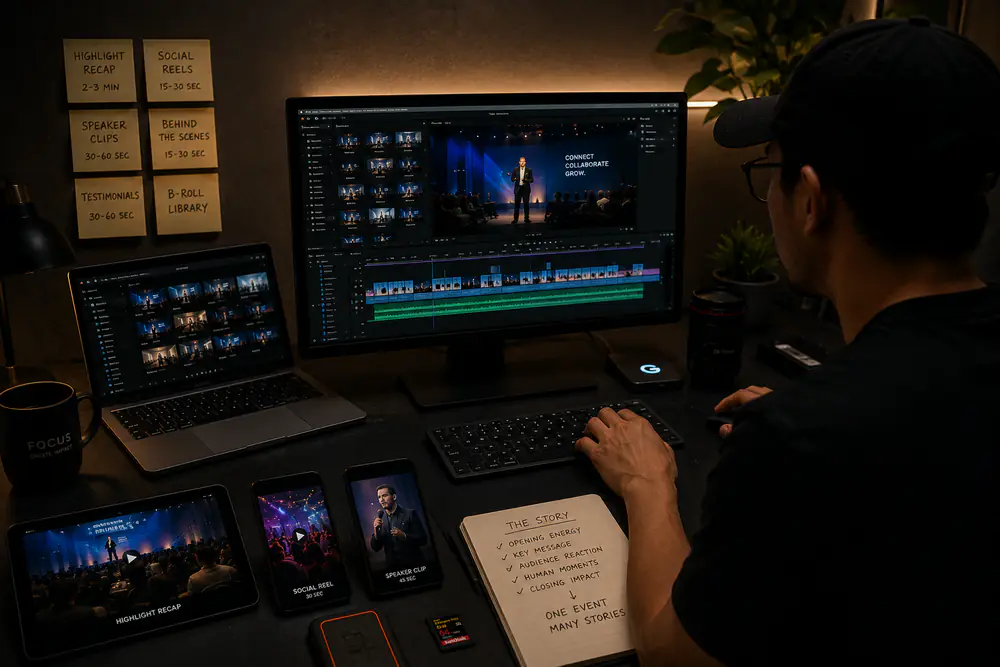
This does not mean overshooting everything. It means capturing with future use in mind.
Editing Is Where The Story Is Built
Shooting captures material. Editing creates meaning.
Post-production is where pacing, music, sound, sequence, emotion, and clarity come together. It is also where many things must be removed. Not every beautiful shot belongs in the final video. Not every important moment is interesting to the viewer. Some scenes need to breathe. Some need to move quickly. Some need sound. Some are stronger in silence.
Shooting captures the material. Editing creates the meaning.
A good edit should not feel like a folder of clips stitched together. It should feel like someone understood the event and shaped the footage with purpose.
Client Feedback Is Part Of The Process
Direct communication is one of the strengths of freelance work. The client can explain what matters, and the videographer can respond without a long chain between them.
But feedback only works when it has purpose. It should not stop at “I like it” or “I do not like it.” Good feedback checks whether the story is accurate, the key people are represented, the tone fits the brand, and the video supports the intended use.
A good video is not only artistically pleasing. It must serve the client’s purpose.
That balance is important. The freelancer brings taste and craft, but the client brings context. When both sides are clear, the final video becomes stronger.
Quality Affects Trust
Many people will only experience the event through the final video.
They were not in the room. They did not hear the speech. They did not feel the atmosphere. They only see what the camera captured and what the editor selected. If the actual event was strong but the video is shaky, dark, messy, badly paced, or poorly edited, the digital memory becomes weaker than the real event.
If the event represents the brand, the video also represents the brand.
This is why “just record something” is not always enough. The way an event is captured becomes part of how people judge the event.
The Human Layer Still Matters
Tools are better now. Cameras are better. Editing software is better. AI can help with transcripts, captions, rough cuts, sound cleanup, and workflow speed.
But tools do not replace judgment.
The value is in what the videographer notices, prioritizes, frames, captures, and edits. It is in the decision to follow a reaction instead of a logo wall, to hold a shot a little longer, to cut a scene that slows the story, or to keep a human moment that makes the video feel alive.
The camera is only the tool. The real value is the judgment behind it.
That human layer is why event videography still depends on taste, timing, and responsibility.
When A Freelancer Is The Right Fit
A freelance videographer can be a strong fit when the event needs agility, direct communication, and a practical content-focused approach.
This is often true for:
- small to medium corporate events
- private launches
- brand activations
- workshops or seminars
- community events
- weddings or private celebrations
- social-first event coverage
In these situations, a freelancer or small team can often stay flexible without making the production too heavy. But the key is choosing someone who understands the job beyond the camera.
You are not only hiring a camera. You are hiring judgment, preparation, reliability, taste, and storytelling.
When A Bigger Production Team May Be Better
A freelancer is not always the right answer.
Some events need multi-camera coverage, live streaming, same-day edits, complex lighting, multiple halls, simultaneous sessions, broadcast-level audio, or very high-stakes brand control. In those cases, a bigger production team may be the better choice.
Professionalism is not pretending you can do everything alone. Professionalism is knowing what the event actually requires.
The goal is not to force every event into a small setup. The goal is to match the production approach to the risk, scale, and purpose of the event.
What Clients Should Prepare
If you want better results, do not only ask for a quotation. Prepare a clear brief.
A useful brief does not need to be complicated, but it should include:
- event objective
- programme flow
- key people and key moments
- required deliverables
- preferred style or references
- platform usage
- deadline and contact person
The clearer the brief, the better the videographer can make decisions on the ground. A good brief gives the freelancer direction without removing their ability to react to the live environment.
A Practical Way To Think About It
For me, freelance event videography sits between creativity and operations.
You need the eye to see the moment, the discipline to prepare, the instinct to react, the communication skill to work with people, and the editing sense to shape the story. You also need enough business understanding to know why the video exists after the event is over.
Event videography is not only a technical service. It is the responsibility of turning a live moment into something people can relive, share, present, remember, and reuse.
That responsibility is what separates a useful event video from a simple recording.
FAQ
What does a freelance event videographer actually do?
A freelance event videographer plans, captures, and edits event footage into useful video content. The work usually includes understanding the brief, preparing equipment, filming key moments, adapting on the day, editing the story, and delivering the final assets.
Is a freelance videographer suitable for corporate events?
Yes, especially for small to medium corporate events, launches, workshops, seminars, brand activations, and content-focused recaps. Larger events with complex technical requirements may need a bigger production team.
What should clients prepare before hiring a videographer?
Clients should prepare the event objective, programme flow, key people, key moments, deliverables, platform usage, deadline, and one main contact person. A clear brief helps the videographer capture with better intention.
When should a bigger production team be used instead?
A bigger team is better when the event requires multi-camera coverage, live streaming, complex lighting, broadcast-level audio, simultaneous sessions, or high-stakes brand control.
How can event footage be reused after the event?
Event footage can become recap videos, short social clips, website visuals, speaker moments, internal updates, sponsor material, proposal support, and future campaign content.
Final Thought
A freelancer’s lens should capture more than the event. It should capture the reason the event mattered.
The best freelance videographers are not valuable only because they are flexible or lean. They are valuable because they stay close to the story, close to the client, and close to the work from planning to delivery.
They prepare like operators, shoot like storytellers, and edit with the final purpose in mind.
A freelance videographer should not just deliver a video. They should deliver an experience the client can relive, reuse, and build from.